About
About Tomas Svitorka
Performance coach for founders and CEOs. Coaching since 2013.
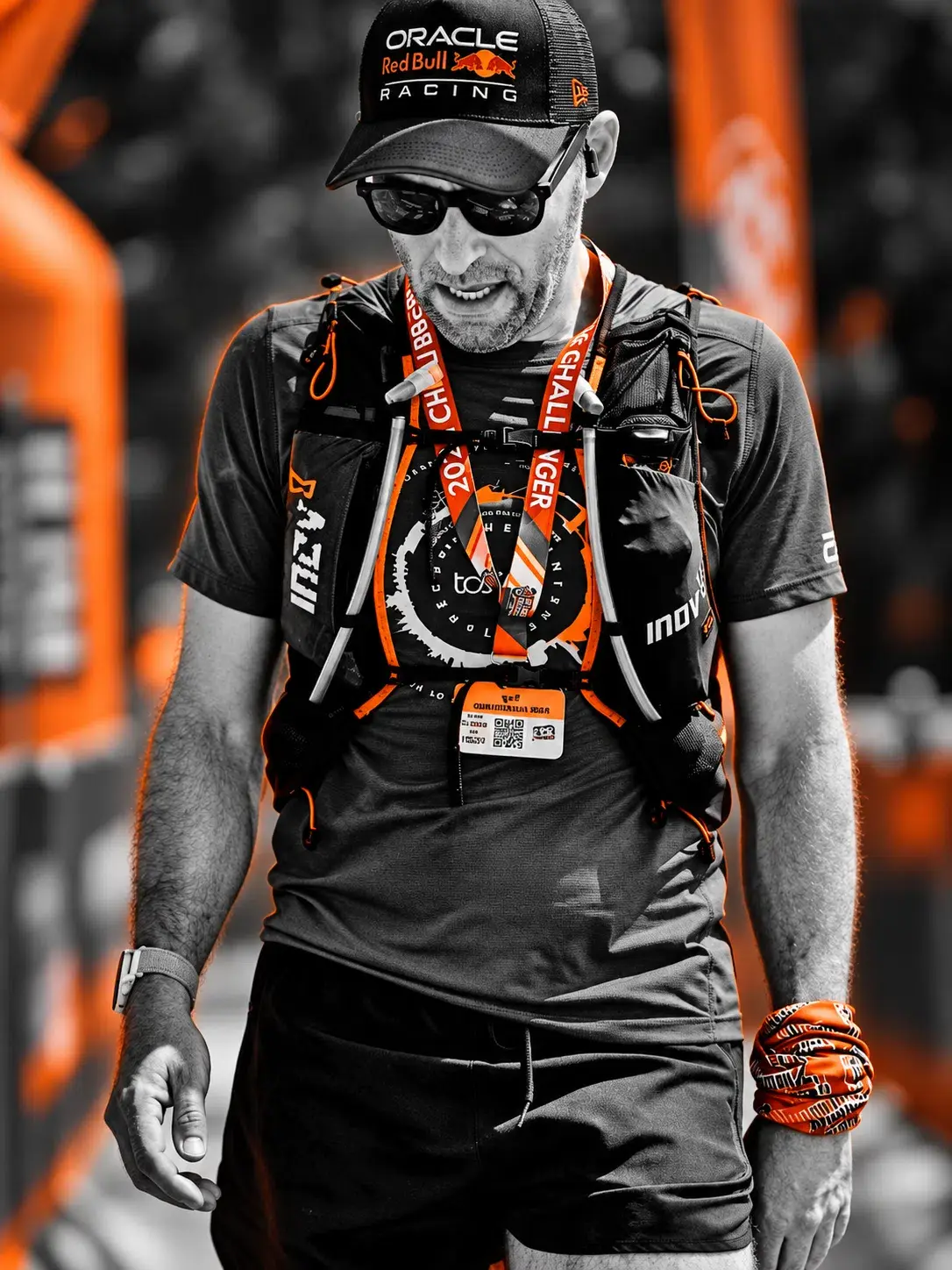
I am a performance coach, based in London and working with clients around the world, across the UK, Europe, the USA and Asia. I have been coaching since 2013 and have worked with over 600 clients, from small business owners to Silicon Valley CEOs, leading Beverly Hills dental surgeons, well known influencers and one billionaire. More than 11,000 hours of coaching went into refining how I work.
I do not have a tragic story. For the first twenty years I had no real idea what to do with myself. Then I found personal development, and it became an obsession. That happened while I was pushing a trolley full of sandwiches. More on that shortly.
01
How I work
I am not a guru of any kind
A business coach works on the business. I work on the person running it. Most founders I meet already know what they and their business need. The challenge is doing it consistently.
I spent my first few years as a coach being too soft, because I assumed people needed support and that honesty would knock them over. It does not. People are not fragile. Most of the people I work with have been surrounded by agreement for years, and what they are short of is somebody who will help them see their situation as it is. That does not mean being cruel or rude. Being straight with someone is a form of respect, and it works best delivered calmly. My favourite question is “What are the facts?”
People are not fragile.
02
Why founders
Why I work with business owners and CEOs
I love entrepreneurship. Building something, selling it, working out why it is not working, then fixing it. Founders and senior executives are the people I connect with most easily, and it took me a while to work out why.
People fall into jobs. Almost nobody falls into starting a business. It asks you to take full ownership of your situation from day one, and that is the trait I like most in the people I work with. It is also why the people I work least well with are the ones who have already decided they are powerless and want me to agree.
Running a business is also lonely in a specific way. You cannot tell your team, because they need you to be the leader. You cannot tell your investors, because they need to see it under control. Often you cannot tell your partner, because then two people are worried instead of one. When I ask clients why they keep coming back, the answer is usually a version of the same thing: I am the person they can work through the things they cannot share with anyone else.
I built my business from nothing over thirteen years, and I have mentored hundreds of founders through Dent since 2017, so I am not guessing about any of this.
What I love most is helping people decide that OK is not enough for them either, and then watching what they do about it.
People fall into jobs. Almost nobody falls into starting a business.
03

Where I started
The Christmas bonus that changed my life
I grew up in a small village in the hills of the Czech Republic. I came to England at 21, spent a year supervising a narrowboat timeshare resort, then moved to London at 23 and took a job in catering, pushing a trolley round the floors of an investment bank, selling sandwiches and coffee to people my own age. The work was easy, which was the whole problem. I had no plan, no direction and no particular complaints. I was coasting.
Then one of my regulars told me what he had been paid as a Christmas bonus. It was around four hundred times more than mine. Four hundred times.
I was not jealous. I was furious with myself, which turned out to be far more useful.
Four hundred times.
04
OK is NOT Enough
That afternoon is where it started, though it took me years to put it into words.
OK is NOT enough may sound like a catchy phrase. But to me it is a standard, and a philosophy I live by. Average is available to everybody and costs nothing to accept. I decided I was not going to.
Everything since has run on that. I wanted more from myself and more from my life, and I was not willing to wait and see whether it turned up.
My aim is to be blissfully dissatisfied. Appreciating what I have while still striving for more. I want to see what I am capable of.
05
Psychology
Psychology, and why I did not become a therapist
Once I had decided I was going to make more of myself and my life, I went at it with everything I had. I read everything I could find, went to every seminar going, and moved from team leader to supervisor to manager. In 2009 I started an evening psychology degree at Birkbeck while keeping the day job, and graduated in 2013.
I loved psychology. I also knew I would not be a great psychotherapist. That work is gentle, slow and largely about healing. I am too fast paced, forward looking and goal oriented for it. Coaching is where I can make the best use of how I am built.
After the degree I threw myself into studying coaching, completed a number of courses, and coached for free for six months to get my hands dirty. Then I charged £25 a session, evenings and weekends, around a full time job. It took two years to transition into a full time business.

06
What I got wrong
I was adding pressure when I needed grease
From the outside I had found “my passion”. On the inside I was panicking. I was starting from scratch at 30, everybody else seemed years ahead, and I felt like I was running out of time. The only answer I could see was to push harder and go faster.
So I chased productivity hacks. Every method, every system, every app, every flavour of hustle culture that came past. I was adding pressure when I should have been adding grease. Each new thing held for a while and then became unsustainable.
It took me a long time to work out that productivity is about subtraction. Almost everything I had picked up was an extra layer of admin sold as a fast track. So I started removing instead of adding, and what survived was a very short list with one thing at the centre of it: the weekly goal tracker I had already been using for years, sharpened into a proper performance review.
I have run that review for over fifteen years now, and it is the one thing I would not give up. That short list is what the C3 Method is built on. I ran it on myself for years before I turned it into a programme.
Productivity is about subtraction.
07

Running
Why I run
I always enjoyed running, but I was not serious about it until 2019, when I decided to challenge myself to finish a marathon. Four months of training, 75 runs, and 950km, which had originally been my target for the entire year.
My goal was to finish under four hours. I crossed the line in 4:02:04.
At first I was frustrated, angry and sad all at once. Where did I go wrong? Where could I have given more? Then I realised I could not have. That was everything I had that day. Nothing left to give and no decision I could point at and call a mistake. If you give it your absolute best, you have won, whatever the target was. That turned out to be quite a profound realisation for me, and I use it with clients constantly.
Save the Rhino
70km ultra, 2023
6h 59m
London to Brighton
100km trail ultra, 2023
13h 45m
London to Brighton
100km trail ultra, 2024
12h 43m
24 hour track race
197km over 492 laps, 2025
24h
Seville Marathon
42.2km, 2026
2h 58m
London to Brighton
100km trail ultra, 2026, 12th of roughly 1,600
11h 27m
I keep going back because running is the most honest feedback system I have found. You cannot cheat it. Speed and endurance have to be earned week by week, and there is no shortcut. Push too hard and you get injured. Skip a few weeks and you lose your fitness. Neglect recovery and the wheels start falling off. Running is where I understood the power of knowing when to hold back, and it applies to business and performance in general far more than most people allow for.
I love ultra running because of the mental side. Once you are several hours in, everything hurts, but your body is not really the problem. Your mind is. It starts negotiating with you, and it makes good arguments.
Sixteen hours into that 24 hour race, my feet were on fire and my body was begging me to stop. I hated running. But I liked who I was being out there, the lunatic who had been going for sixteen hours and was going to do eight more.
I do not know where my limit actually sits. I would like to find out.
None of this came naturally to me. Consistency is a skill I built deliberately, through structure and repetition, which is exactly why I can teach it.
08
The Guardian sent me one of their writers.
He was falling behind on his work, stuck in a funk, and not producing at the level he was capable of. Covid was doing what Covid did.
Three months later he was thinking in long-term projects, planning years ahead, and moving again after a long stretch of standing still. He wrote it up honestly in the Saturday magazine.
He came back later, on his own, while writing his second book. He thanked me in the acknowledgements of Four Stars: A Life. Reviewed. (HarperCollins).
Read the full Guardian article →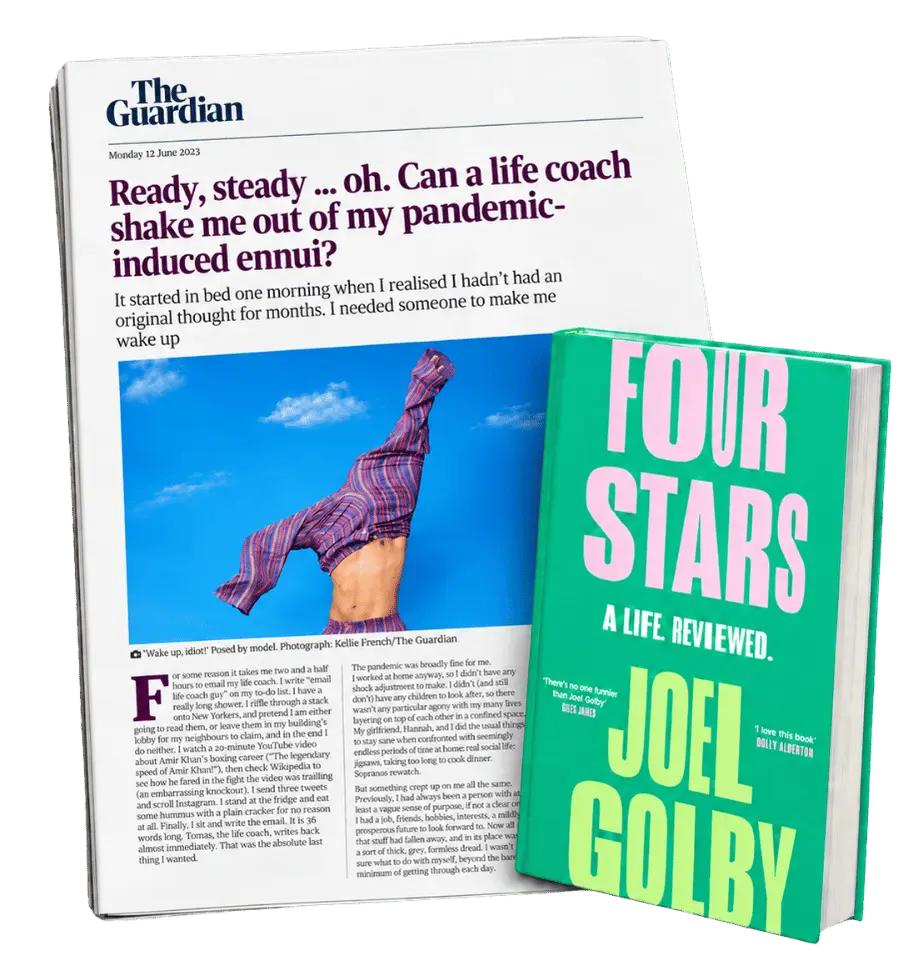
09
Credentials
The paperwork
BSc Psychology, Birkbeck, University of London
Four years of evidence-based psychology, studied in the evenings while working full time. It taught me how the mind works, how behaviour gets reinforced or broken, and why we do things that make no sense to us. I think and work like a scientist.
Mentor, Dent Global startup accelerator, since 2017
I went through the programme myself and won their Threshold Business of the Year award, after which they invited me to become one of their mentors. I teach the sales module to founders scaling their businesses, which keeps me in the room with the people I coach, working on real commercial problems rather than theory.
The rest, for anyone who wants it:
Coaching since 2013. 600+ clients. 11,000+ hours.
Coaches Training, Strategy Coaching, Accountability Coaching and Assessment Coaching certifications, Master Coach University
NLP Practitioner, NLP Life Training
5.0 on Google across 25 reviews
Featured in The Guardian, GQ, Virgin, Vice, Thrive Global and Brainz
10

Off the clock
When I am not working
I live in London with my wife Kriz and our golden retriever Lulu. Training Lulu has taught me more about how brains actually work than several of the books on my shelf. She knows dozens of tricks, and every one of them was built the same way: small steps, repeated, rewarded honestly.
Outside work it is running, AI, astronomy, physics and anything to do with how the brain works. I am not a natural at switching off, which is why I schedule it like everything else.
I am from a small village in the hills of the Czech Republic.
I was in a metal band. Long hair, leather, the lot.
I have run 197km in 24 hours on a 400 metre track. That is 492 laps.
I collect certifications. Among others I am a Costa certified barista, a qualified forklift driver and a licensed security guard.
One day I want to do a degree in astrophysics.
I have always wanted to try fried insects.
I am extremely particular about which mug I drink from.
I do not drink tap water.
11
Coaching
Two ways to
work with me.
Personal Coaching
For founders and executives who have too much to juggle and too many decisions to make. I help you troubleshoot the things you cannot talk to anyone else about. We focus on whatever matters most at the time with support between the sessions.
The C3 Method
A structured programme for founders and executives who want to up their productivity and stay consistent with it without burning out. You get weekly sessions and accountability in between.
Strategy Session
Book a
Strategy Session.
A proper conversation, not a sales call. We look at where your performance is actually breaking down, what it is costing you, and whether coaching is the right answer.
It runs up to 90 minutes. Most people leave with more clarity than they arrived with, whether or not we work together.
If we are a good fit, we talk about next steps. If we are not, I will tell you.
5.0 on Google
25 reviews
